


Choosing between an oil-free and a lubricated compressor is one of the most consequential engineering decisions in any biogas or biomethane project. The compression technology you select directly affects gas purity, maintenance costs, regulatory compliance, equipment lifespan, and the long-term profitability of the entire plant.
At Fornovo Gas, we develop oil-free and no-lube reciprocating compressor solutions for biogas, biomethane, CNG, hydrogen and selected oil & gas applications. Our DA500, DA300 and SA200 compressor are backed by more than 55 years of compression engineering experience, over 3,500 compressors installed worldwide and a presence in more than 60 countries. This article provides an engineering-driven comparison between oil-free and lubricated compression technologies, with a focus on the technical and operational factors that matter in biogas and biomethane projects.
Why oil contamination threatens biogas plants
In a lubricated reciprocating compressor, oil serves a dual purpose: it lubricates the piston rings and cylinder walls to reduce friction, and it helps seal the compression chamber to minimise gas leakage between stages. The problem is that a portion of this lubricating oil inevitably migrates into the gas stream – a phenomenon known as oil carryover.
In conventional industrial gas compression, small amounts of oil carryover are often tolerable. But biogas and biomethane applications impose far stricter requirements, for several interconnected reasons:
Gas purity and grid injection standards
Biomethane destined for grid injection must meet national gas quality standards (such as those defined under ISO 16723 or country-specific network codes). These standards set maximum thresholds for contaminants including oil, particulates, and moisture. Even trace levels of oil vapour in the compressed gas can cause grid injection points to reject the biomethane, resulting in production downtime and revenue loss.
Upgrading system integrity
Biogas upgrading technologies – whether membrane separation, pressure swing adsorption (PSA), or water scrubbing – are sensitive to oil contamination. Oil fouling on membrane surfaces reduces separation efficiency over time, while oil deposits in PSA adsorbent beds can permanently degrade their performance. In practice, this means that a lubricated compressor upstream of the upgrading unit creates a contamination risk that must be managed through additional filtration and coalescing systems, adding complexity and cost.
Downstream equipment damage
Oil carryover does not stop at the upgrading system. It can contaminate downstream storage vessels, pipeline infrastructure, CNG dispensers, and even end-user equipment. In biomethane vehicle fuelling applications, oil-contaminated gas can damage engine components and catalytic converters. The cumulative cost of downstream contamination events often dwarfs the initial savings from choosing a lower-cost lubricated compressor.
Environmental and regulatory exposure
Used compressor oil from lubricated systems must be collected, stored, and disposed of as hazardous waste under EU regulations. In a biogas plant environment, where sustainability credentials are often central to the project’s business case and public image, the ongoing generation of oil waste creates both a regulatory compliance burden and a reputational risk.
Oil-free compressor technology explained
Oil-free reciprocating compressor technology eliminates lubricating oil from the compression chamber entirely. Instead of relying on oil to lubricate and seal the piston-cylinder interface, oil-free compressors use specially engineered dry-running components:
- Self-lubricating piston rings and rider bands – typically made from PTFE-based compounds or carbon-filled polymers that provide low-friction contact without any liquid lubricant. These materials are selected to withstand the chemical aggressiveness of biogas, including H₂S and moisture.
- It is important to distinguish between oil-free and no-lube compressor designs. At Fornovo Gas, oil-free configurations are engineered to prevent lubricating oil from coming into contact with the process gas, which is essential in applications where gas purity is a critical requirement. No-lube configurations are also based on dry-running technology, with material selection and design parameters defined according to the specific gas composition, pressure range and operating conditions of the project.
- The design of the Fornovo Gas oil-free compressor range is based on long-standing reciprocating compressor engineering know-how and project-specific design criteria. The engineering phase may include advanced calculation tools, virtual prototyping and structural analysis to verify mechanical integrity, performance and reliability before manufacturing.
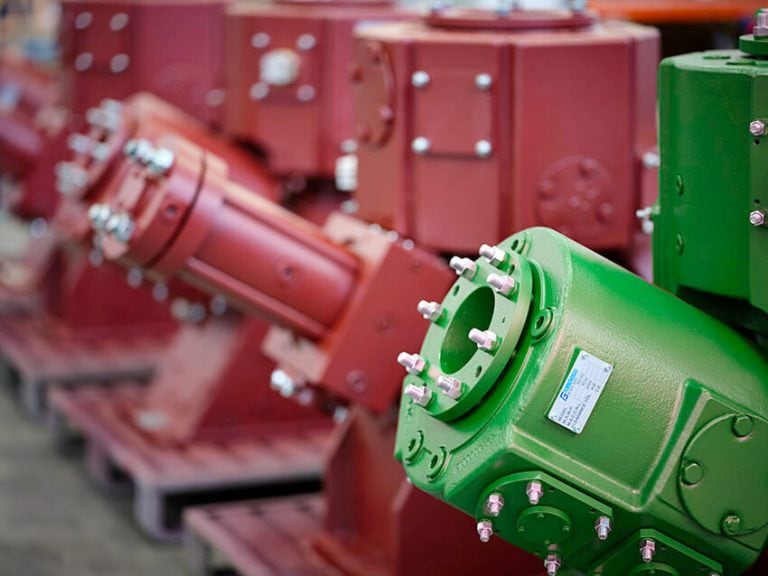
The DA500 Oil Free is Fornovo Gas’s horizontal reciprocating compressor for demanding gas compression applications. Its final configuration, power rating, cylinder arrangement, stroke selection, cooling system and operating speed are defined during the engineering phase according to flow rate, suction pressure, discharge pressure, gas composition and project requirements.
How Fornovo Gas engineered its oil-free compressor range
The design of the Fornovo Gas oil-free compressor range is based on API 618 guidelines with additional optimisations developed over three decades of reciprocating compressor manufacturing. Our design team uses virtual prototyping techniques, including advanced FEM (finite element method) analysis, to simulate realistic workloads during the design phase – well before a single component is machined.
Technical comparison: oil-free vs lubricated compressors for biogas
The following table provides a side-by-side comparison across the technical and operational parameters that matter most in biogas and biomethane compression:
| Parameter | Oil-free compressor | Lubricated compressor |
| Oil in gas stream | Designed to avoid lubricating oil contact with the process gas | Oil carryover risk depending on design, operating condition and filtration efficiency |
| Gas purity | Avoids oil contamination at the source, supporting high gas purity requirements | May require downstream oil separation and filtration depending on gas quality requirements |
| Piston ring material | PTFE-based or carbon-filled polymer compounds designed for dry running in aggressive gas environments | Metallic or composite rings designed to run in an oil film |
| Ring and packing wear | Dry-running wear components require planned inspection and replacement according to the Maintenance Plan | Ring wear may be lower, but oil-system maintenance and filtration management remain part of the scope |
| Oil consumption | Zero
|
Oil consumption depends on compressor size, design, operating conditions and maintenance status |
| Oil disposal | None required | Used oil must be managed as hazardous waste, generating disposal costs and regulatory obligations |
| ATEX compliance | No oil injection on the gas-contact side; ATEX assessment remains project-specific | Oil mist/vapour considerations must be assessed within the complete ATEX risk analysis |
| Suitability for upgrading systems | Ideal – no risk of membrane fouling, PSA bed contamination, or water scrubbing impairment | Oil carryover can damage upgrading technology components, requiring additional protection measures |
| Sound insulation | Project-specific soundproofing solutions according to site noise requirements | Comparable acoustic performance may be achievable depending on package design |
| Capital cost | Higher initial investment | Lower initial purchase price |
| Operational cost (10-year) | Potentially lower TCO in suitable applications, depending on operating profile and maintenance strategy | TCO depends on oil system maintenance, filtration requirements and contamination risk management |
Maintenance cost comparison: what the numbers actually show
One of the most frequent questions we receive from plant operators and procurement teams is whether the higher upfront cost of an oil-free compressor is justified by lower operating expenses over time. Based on our experience with installations across Europe, the answer is consistently yes – and the differential is significant.
Maintenance tasks eliminated by oil-free technology
- Oil changes – lubricated compressors require oil changes at intervals of 2,000–4,000 operating hours, depending on the oil type and gas composition. Each change involves draining, refilling, and disposing of used oil. An oil-free compressor eliminates this task entirely.
- Oil filter replacement – the lubrication circuit includes filters that must be replaced at every oil change or more frequently in dusty or corrosive environments. Oil-free systems have no lubrication circuit and therefore no oil filters.
- Coalescer and activated carbon filter servicing – to protect downstream equipment from oil carryover, lubricated compressor installations typically require coalescing filters and activated carbon beds. These consumables add ongoing cost and require regular monitoring and replacement.
- Oil separator maintenance – many lubricated compressor packages include oil separators to reclaim oil from the compressed gas. These separators require periodic servicing and eventual element replacement.
Maintenance tasks that remain the same
It is important to note that oil-free compressors are not maintenance-free machines. Certain tasks are required regardless of the lubrication technology:
- When all factors are considered – reduced oil handling, lower filtration requirements, fewer contamination-related risks and simplified maintenance activities – oil-free technology can provide a favourable total cost of ownership compared with lubricated alternatives. The actual maintenance cost impact depends on compressor size, operating hours, gas composition, site conditions and local service costs.
- Valve inspection and servicing – compressor valves require periodic inspection in both oil-free and lubricated designs.
- General mechanical inspection – bearings, crossheads, connecting rods, and other crankcase components still require routine inspection and lubrication (the crankcase of an oil-free compressor is still lubricated – it is only the gas-contact side that is oil-free).
Net maintenance cost impact
When all factors are combined – eliminated oil costs, eliminated filtration consumables, reduced hazardous waste disposal, and the simpler ring change procedure – our customers consistently report maintenance cost reductions in the range of 15–25% compared to equivalent lubricated installations. The exact figure depends on the plant’s operating hours, gas composition (more aggressive gases accelerate ring wear), and local labour costs, but the directional advantage of oil-free technology is clear across all scenarios we have analysed.
Fornovo Gas supports this advantage with dedicated maintenance agreements, strategic spare parts stocking, and training courses for customer maintenance technicians – ensuring that the operational cost benefits of oil-free compression are fully realised over the equipment’s entire lifecycle.
Gas purity requirements and how compression technology affects them
The end use of the compressed biomethane determines the gas purity requirements, and therefore directly influences the choice between oil-free and lubricated compression:
Grid injection
National grid codes across Europe specify maximum allowable concentrations of hydrocarbons, particulates, and moisture. Oil carryover from a lubricated compressor contributes to the hydrocarbon load in the gas. While downstream filtration can reduce this, it introduces a single point of failure: if a coalescer element fails or is not replaced on time, the gas quality breach can result in grid injection refusal and immediate revenue loss. Oil-free compression eliminates this risk at the source.
Biomethane liquefaction (bio-LNG)
LNG production requires extremely low levels of contaminants to prevent freezing and fouling in the cryogenic process. Oil traces, even at parts-per-million levels, can solidify at liquefaction temperatures and block heat exchangers or damage turboexpanders. Oil-free compression is strongly preferred – and in many cases specified as mandatory – for biomethane-to-LNG applications.
High-pressure storage and CNG distribution
For biomethane stored at pressures up to 250 bar in cylinder trailers or vehicle refuelling stations, oil contamination can degrade seals, accumulate in storage vessels, and compromise the quality of gas delivered to end users. Fornovo Gas oil-free compressors are engineered for these high-pressure applications, delivering gas at storage pressure without introducing any contamination.
Upgrading system feed gas
When the compressor sits upstream of the upgrading system (compressing raw biogas before it enters the membrane, PSA, or water scrubbing unit), oil contamination poses a direct threat to upgrading efficiency. Membrane materials in particular are highly sensitive to oil fouling, and the resulting performance degradation can reduce methane recovery rates and increase operating costs significantly over time.
Long-term ROI analysis: when does oil-free pay for itself?
The central economic question is straightforward: does the higher capital cost of an oil-free compressor generate enough operational savings to deliver a positive return on the incremental investment? Based on our project data across European biomethane installations, the answer is typically yes, with payback periods that are shorter than many operators initially expect.
Cost factors favouring oil-free technology over 10 years
- Oil procurement savings – a medium-sized lubricated compressor operating 8,000 hours per year can consume 4,000–16,000 litres of specialty compressor oil annually. Over a 10-year plant life, these costs accumulate substantially.
- Filtration consumable savings – coalescer elements, activated carbon beds, and oil separator cartridges represent a recurring expense that does not exist in oil-free installations.
- While every project is different, the economic advantage of oil-free technology should be evaluated through a project-specific total cost of ownership analysis. Payback depends on operating hours, compressor configuration, oil and filter consumption avoided, maintenance strategy, gas quality requirements and the cost of any downstream contamination risk.
- Avoided contamination events – even a single grid injection rejection or upgrading system fouling event can cost tens of thousands of euros in lost production,
- emergency servicing, and remediation. Oil-free technology eliminates this risk category entirely.
- Reduced maintenance labour – fewer maintenance tasks mean fewer service hours, which translates directly into lower labour costs and reduced production downtime.
- Extended downstream equipment life – upgrading membranes, PSA beds, and downstream storage components last longer when they are not exposed to oil contamination, reducing replacement and refurbishment costs over the plant’s lifetime.
Indicative payback timeline
While every project is different, the typical pattern we observe is that the incremental cost of oil-free technology is recovered within 18 to 36 months of continuous operation. After that point, the oil-free compressor delivers pure net savings for the remainder of its operational life. For a plant designed to operate 15–20+ years, the total cost of ownership (TCO) advantage of oil-free compression is compelling.
We encourage prospective customers to request a detailed TCO comparison from our engineering team, tailored to their specific project parameters – including gas composition, operating hours, pressure requirements, and local cost variables. This analysis is part of the consultancy process Fornovo Gas provides during the quotation phase.
When lubricated compression may still be appropriate
In the interest of providing a balanced and technically honest assessment, there are scenarios where lubricated compression remains a viable choice:
- Non-critical gas purity applications – if the compressed biogas is used directly for on-site power generation (e.g., feeding a CHP unit) rather than being upgraded to biomethane, the gas purity requirements are less stringent, and oil carryover is less problematic.
- Extremely high-pressure applications with challenging gas compositions – certain niche applications with unusual pressure ratios or gas properties may benefit from the additional sealing provided by an oil film, although advances in dry-running materials have significantly narrowed this gap.
- Budget-constrained pilot or temporary installations – for short-duration projects or proof-of-concept plants where minimising upfront capital is the overriding priority and long-term operating costs are less relevant.
However, for any biomethane project involving grid injection, LNG production, high-pressure storage, or CNG distribution, oil-free compression is the technology that the market has moved toward decisively – and with good reason.
How biogas composition affects your compressor choice
Biogas is not a uniform gas – its composition varies depending on the feedstock (agricultural waste, landfill, industrial wastewater, food waste) and the digestion process. The key variables that influence compressor selection include:
- Hydrogen sulphide (H₂S) concentration – H₂S is highly corrosive and can rapidly degrade standard metallic components. Both oil-free and lubricated compressors require corrosion-resistant materials when H₂S levels are significant, but oil-free designs avoid the complication of H₂S-contaminated oil disposa
- Moisture content – saturated biogas creates condensation within the compression chambers. In lubricated systems, water emulsifies with the lubricating oil, degrading its protective properties and accelerating wear. Oil-free compressors handle wet gas conditions without this secondary failure mode.
- Siloxane levels – siloxanes in the gas stream can form abrasive silicon dioxide deposits on hot surfaces. Both technologies are affected, but the absence of oil in oil-free systems simplifies the cleaning and inspection process.
Fornovo Gas compressors are custom-engineered for each project’s specific gas composition. Our engineering team evaluates the full gas analysis – including methane content, CO₂ percentage, H₂S, moisture, siloxanes, and other trace components – before specifying materials, ring compounds, surface treatments, and operating parameters. This bespoke approach ensures that whether you choose oil-free or non-lubricated technology, the compressor is optimised for your actual gas conditions, not generic assumptions.
Fornovo Gas oil-free compressor range at a glance
| Model | Configuration | Power | Key features |
| DA500 Oil Free | Horizontal, 1/2/4/6-cylinder | Up to 1800
|
Horizontal reciprocating compressor family for demanding gas compression applications; configuration, cooling system, speed and cylinder selection are defined project by project |
| DA300 Oil Free | Vertical
|
Up to 315kW | Compact vertical reciprocating compressor solution for selected medium-capacity applications, depending on required flow rate and pressure range |
| SA200 Oil Free | Vertical
|
Up to 55kW | Efficient and compact reciprocating compressor solution for selected applications, including smaller plants and space-constrained installations |
All models are available with ATEX certification (Zones 1 and 2), PED, Machinery Directive, and EMC Directive compliance. Fornovo Gas also holds ISO 9001, ISO 14001, ISO 45001, and Achilles validation (sustainability score 88/100), providing the full quality and compliance infrastructure that EPC contractors and plant operators require.
